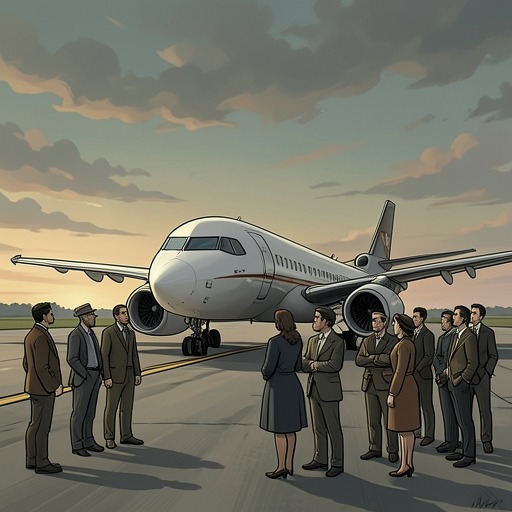
Quarantine of Air Gradia Flight 452
Station ElevenThe quarantine of Air Gradia Flight 452 at Severn City Airport marks the shift from a world where air travel made distance manageable to one where an aircraft could become a danger that people could neither safely enter nor leave. Diverted amid the spread of the Georgia Flu, the flight remained sealed on the tarmac while the stranded passengers faced an unanswered question: whether opening it would bring fatal contagion into the terminal.
Diversion and the warning
Clark Thompson was aboard the flight after leaving New York for Toronto. He had planned to arrive before a predicted snowstorm, and only noticed Elizabeth Colton and her son Tyler Leander on the same plane after boarding. About an hour and a half after takeoff, the pilot announced a diversion to an unfamiliar airport in Michigan. The passengers disembarked at Severn City Airport, confused and disoriented.
Outside the terminal, the ordinary language of air travel persisted after its usual assurances had failed. An overhead screen still announced the arrival of Air Gradia Flight 452, while a radio crackling at the ticket counter supplied the word quarantine. The Air Gradia agent there was in tears. Roads were impassable, commercial airlines had shut down, and passengers who tried to leave found no ground transportation. About a hundred people remained in the terminal, with no official arriving to move them on.
The plane remains sealed
The passengers could see aircraft parked end to end on the tarmac, but no one emerged from the Air Gradia jet. Some people in the terminal had covered their mouths and noses with scarves or shirts; Clark wondered whether anyone would have fallen ill by then if infection were inevitable. He walked repeatedly through unmanned security checkpoints, finding their unexpected openness frightening rather than liberating, then withdrew to a distant corner and watched the others for signs of illness.
The decision to keep Flight 452 sealed was shaped by uncertainty and the risk to the people in the terminal. No one knew whether the virus could be contracted from the dead, and opening the aircraft might expose a crowded airport to fatal infection. The plane’s continued closure became an unspoken agreement: people avoided discussing it, and Clark tried not to look toward it or dwell on what the decision had required. Its silence did not resolve what was inside; it made the uncertainty part of the survivors’ daily life.
A quarantine that outlasts the arrival
The quarantine’s consequences extended beyond the moment the warning was heard. Flight 452 remained near the airport perimeter, apart from the concourses where the stranded population tried to establish routines. Clark later thought of the aircraft as a mausoleum, a description that captures how containment and memorial became difficult to separate. The people inside were absent from view but not from the airport’s consciousness: the survivors’ agreement not to speak of the plane depended on knowing it was there.
The aircraft also became a focus for competing interpretations. Tyler later said that he was reading to the people inside and wanted them to know that what had happened had happened for a reason. Clark answered that there was no one there, while recognizing the plane as a place holding the dead. Their exchange shows how the sealed jet could be understood at once as a practical barrier against contagion, a burial place, and an object onto which Tyler placed a larger explanation.
Meaning of the sealed flight
Before the collapse, planes still connected distant places and made movement seem ordinary. Elsewhere in the post-collapse world, aircraft remained on runways and in hangars, repurposed for storage or left to weather. Flight 452 gives that broader loss a concentrated form: it arrived carrying people, but its arrival did not lead to a safe passage onward. The passengers were stranded, the aircraft was inaccessible, and the old confidence that travel could carry people out of danger had given way to containment without certainty.